

With 2025 now in the rearview mirror, the impact of tariffs and trade barriers is clearer for some sectors and industries, while others still await. For example, the Canadian aluminum industry now likely knows its worst-case scenario and Canadian grocers have adapted to tariffs and consumer soft boycotts of US products. On the other hand, the auto industry impact in the USA and Canada is still at the mercy of the trade negotiations to unfold in the year ahead.
With this in mind, it is increasingly valuable to look for investment opportunities where the investment markets seem to be pricing in a worst-case scenario in lieu of areas where investors seem purely optimistic.
Bonds and Interest Rates
In general, interest rates reflect the outlook on whether the economy is too hot (as indicated by factors like high inflation) or too cold (as indicated by factors like high unemployment.) Facing that constant tug-o-war, interest rates rise and fall to adapt. As 2025 unfolded, the fear of inflation induced by US tariff rate hikes in April caused long term interest rates to rise (and bond prices to fall) into the summer. Then interest rates fell again (and bonds rose) in early fall before pulling back in November-December. Rates are so jumpy because geopolitical actions spurred by the Trump administration are so dramatic that they create much more economic uncertainty than normal. One minute we see a signal the economy is heating up and the next minute we see some other signal showing it is cooling off. At moments like this we need to stay calm and focus on what we know. In the long term, good businesses tend to survive through these wilder short-term gyrations.
One major factor impacting inflation is the price of oil. Oil is a cost component of many products, either because of embedded transportation costs, plastics costs, or process heating. When oil prices decrease, the inflationary pressure is reduced across the economy as a whole. US oil has fallen in price from around $80/barrel at the beginning of 2025 to around $58/barrel by the end of the year. This is a significant help in cooling inflation.
I expect it will be a long time before we ever see long term interest rates below 2% like we did in the 20-teens but despite the month-to-month fluctuations, I do see long term rates in the US (the primary bond market) eventually stabilizing in the 4.0% to 4.5% range. The longer they remain there the more feasible it is for the US mortgage market (and hence the housing market) to gradually thaw out and become more active beyond just participation by desperate sellers and deep-pocketed cash buyers. Something roughly similar should transpire in Canada too.
Right now, long term US government interest rates are in the low 4% zone and there is some chance of them rising slightly from here (bad for bond holders) due to spending triggers slightly boosting inflation. Those include: 2026 chance for US corporations to repatriate cash from abroad tax-free (and then presumably spend it), tax break/bonus being paid out to US consumers. These two sources of cash would both goose the economy. As a result, we are less eager to hold long-dated US government bonds than in the past.
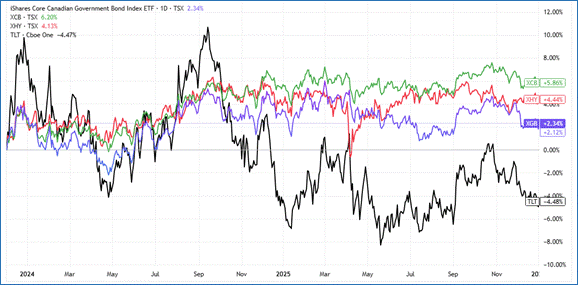
Fig. 1: Bonds-Med. term Cdn Gov’t-purple, Cdn Corp-green, High Yield-red, Long Term US-black – 2 years – TradingView
Another factor we often look at to assess the economy and investor optimism is the gap between interest rates paid on government bonds and interest rates paid on corporate bonds (what is known as the corporate spread). When the corporate spread is very small, the interest you earn on corporate bonds is not much higher than what you would earn on a government bond. This implies investors do not see much incremental risk in corporate bonds over government bonds. Extremely small spreads can be interpreted as frothy overenthusiasm and that is what we are witnessing right now.
Our expectation for government bonds and for the corporate spread are both driven by our slight adjustment on our economic outlook. A year ago, we expected challenges brought by tumultuous US government behaviour would inevitably lead to recession but now, with the government having walked back some extreme positions and the economy having muddled through, we see the chances of a recession ahead as more of a 50:50 chance rather than an almost certainty.
Currencies
During 2025, the USD weakened through the first half of the year before slightly recovering strength in summer and early fall. Finally in November and December the USD again weakened somewhat against the CAD and even more against a basket of global currencies. By the end of the year the USD was trading at roughly $1.37 CAD per USD or around $0.72 USD per CAD on the reciprocal.
Fig. 2: US Dollar Index-green and USD vs CAD-purple – 2 years – TradingView
From a Canadian’s perspective, the moves vs the CAD are most important. Two meaningful drivers this year will be 1) the chance of a recovery in the price of oil, which usually provides strong support for the CAD and 2) the Canada USA Mexico Agreement (CUSMA) which is up for review in July. I would expect there will be some weakness in the CAD related to that extension but it won’t last long. The US government will want to talk tough but as it relates to the auto industry the incumbent US government cannot afford a meltdown going into their November midterm elections. If there is meaningful weakness of the CAD related to those negotiations, we may consider using that as an opportunity to sell USD investments and buy CAD investments at good prices.
Stock Markets
Broadly speaking, equity markets pulled back early in November before recovering into the year end. The Japanese market was the surprising strong outperformer this quarter and the US market was relatively weak. This US weakness was primarily due to exhaustion in technology stocks after a long run. Tech stocks have lately been an underperformer as other sectors show stronger results. Because the US index is much more tech weighted than those in the rest of the world, weakness in tech leads to relative weakness in the US index (S&P 500).
One factor that helped Canada’s performance overall, was the incredible performance of gold, silver, and precious metals stocks. In our smaller accounts we shifted from US indices to Canadian indices earlier in the year. This implicitly gave them less exposure to tech and more exposure to precious metals. In most accounts we also took a position earlier in the year in a physical gold pool, which gave us exposure to this rising gold price trend, which many pundits describe as a flight to safety. Recently we actually began selling a fraction of this gold position to lock in some profits.
Fig. 3: Stocks: US-black, Can-purple, Jpn-red, UK-yellow, Germany-green – 2 yrs – Trading View
From a sectoral perspective, we should see the struggles of the housing market start to abate going forward. Also, other sectors which have been strained by consumers coping with inflation should see their challenges begin to ease. This implies that some consumer discretionary companies that have been really exposed to a strong headwind will see easier days ahead and the potential to recover from the consumer restraint of the past couple years.
Respectfully submitted,

Paul Fettes, CFA, CFP, Chief Executive Officer, Brintab Corp.
Leave a Reply